Teaching – Tai Chi and beyond
Tai Chi training can take many forms, from individual lessons focused on personal development to group sessions that build awareness, focus, and calm in a shared environment. At the moment, training in Sydney is available through private sessions, while group and corporate programs can be arranged upon request. Whether you’re seeking a grounded daily practice, stress reduction for your team, or a deeper understanding of body-mind connection, Tai Chi offers a way to move, breathe, and realign both physically and mentally.
How does Tai Chi training actually work?
Tai Chi can be approached in many different ways. What you’ll find here is a look into the classical system — a practice that develops awareness, alignment, and energy through mindful movement. Depending on the person, the focus may differ: some students wish to explore the meditative side, learning stillness and inner calm, while others are drawn to the martial roots and prefer to work on applications and self-defense from the start.
No matter the approach, the underlying principle remains the same: reconnecting body and mind to move naturally and effortlessly.
Classic Tai Chi training begins very simply: by following movements while becoming aware of yourself. Through this process, you gradually build a deeper connection between body and mind, improving posture, balance, and inner calm.
Body Alignment and Correction
One of the main challenges today is that our daily posture, shaped by hours in front of computers and smartphones, has become unnatural. We can no longer feel whether they are truly standing upright or leaning slightly forward or backward.
In Tai Chi, we aim to realign the body so that the ankles, hips, shoulders, and ears rest on one relaxed vertical line. From this neutral position, we learn to release unnecessary tension and allow the body’s weight to sink downward. Over time, this creates a remarkably stable stance — one that gives others the impression that you are almost impossible to move.
In Tai Chi, we aim to realign the body so that the ankles, hips, shoulders, and ears rest on one relaxed vertical line. From this neutral position, we learn to release unnecessary tension and allow the body’s weight to sink downward. Over time, this creates a remarkably stable stance – one that gives others the impression that you are almost impossible to move.
Here I’m working with a student in Brazil who has been practicing Tai Chi for a few months. The two photos show her posture before and after the correction — the difference speaks for itself:

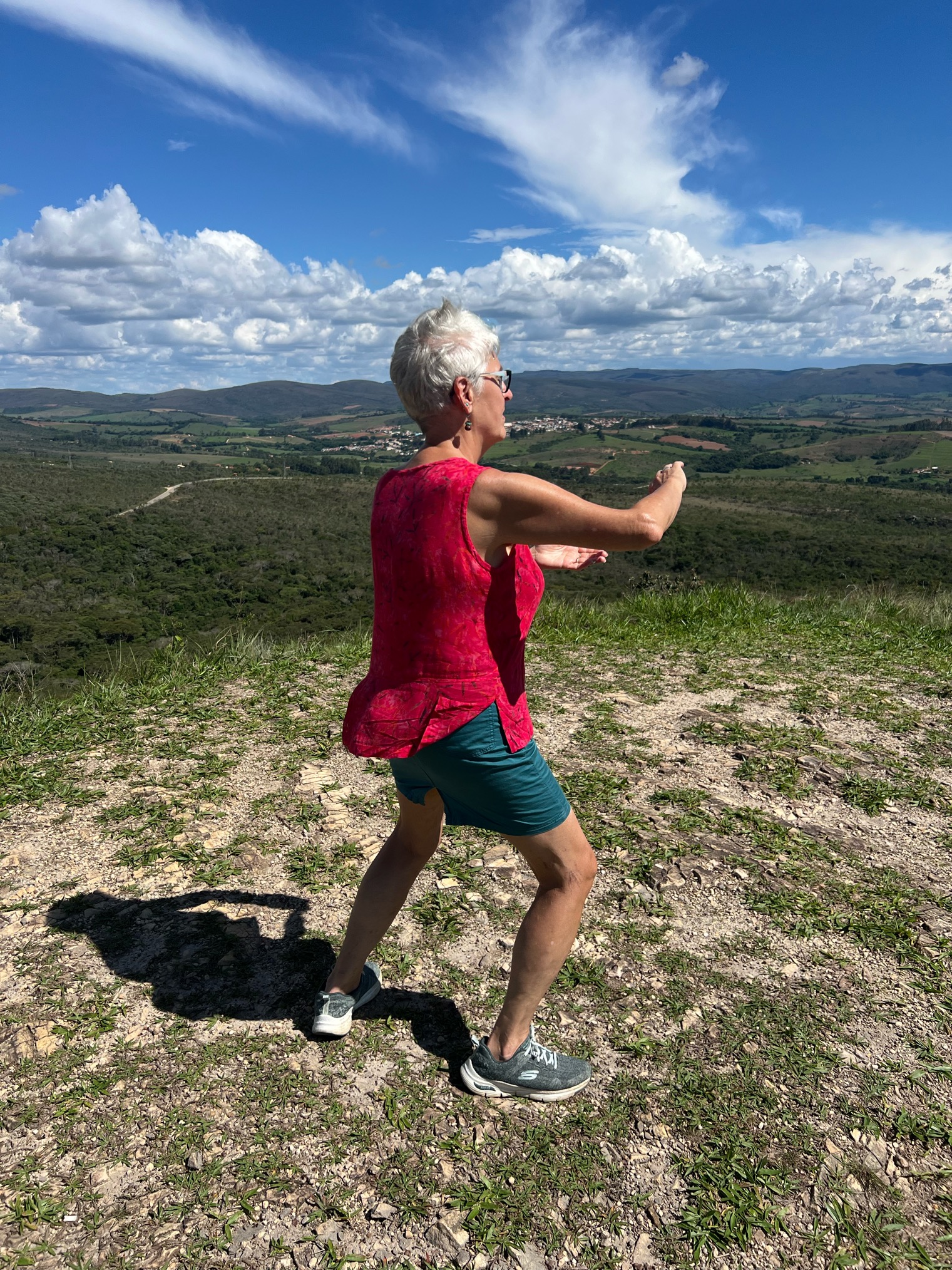
The process works by observing the practitioner as a whole and gently adjusting each part of the body so it can stand naturally, without strain. When the structure is aligned, energy can flow freely and the body’s weight can naturally sink downward. Particular attention is given to relaxing the shoulders, opening the hips, and letting the lower back release.
The skill of the Tai Chi teacher lies in perceiving and improving each student’s unique patterns of tension and imbalance. Through these corrections, not only does the body become relaxed, but ideally, the mind also becomes clear and empty.
Why practice Tai Chi?
Tai Chi goes beyond exercise — it’s a method of reconnecting with how your body naturally moves. Regular practice enhances coordination, balance, and resilience, while calming the mind and nervous system.
For a deeper look at the wide-ranging physical and mental benefits of Tai Chi, visit the Benefits page.