Chen Style Tai Chi System
This page introduces the structure and key elements of the Chen Style Tai Chi system, showing how physical structure, energy work, and martial principles are woven into one cohesive art. It provides a clear overview of the essential methods and ideas that define this classical tradition.

Standing posture 太極站桩
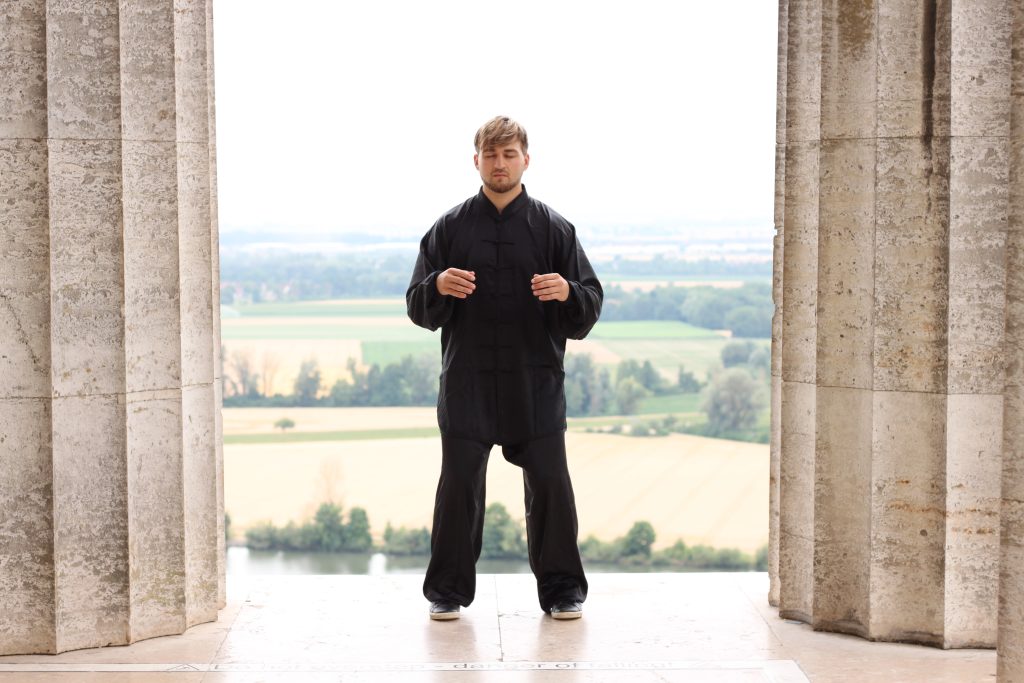
The foundation of Chen Style practice.
In standing meditation, the practitioner cultivates stillness and internal awareness while maintaining an aligned structure. The body relaxes without collapsing, developing stability and sensitivity. This practice strengthens the deep postural muscles and builds a clear connection to the body’s center of gravity (Dantian). Through this stillness, willpower and inner calm are developed.
Linking internal and external movement.
These spiral-based exercises teach the essential movement patterns of Tai Chi – smooth, continuous, and circular. Silk reeling helps harmonize upper and lower body, integrates breathing with motion, and refines energy flow through coordinated rotation and weight transfer. There are 19 classical variations, each exploring a specific quality of motion and internal force.
Silk Reeling 太極的蠶絲功
To illustrate the training method, I describe the first silk-reeling exercises below, focusing briefly on both the physical mechanics and the internal energy flow:
The One-Arm Frontal Silk-Reeling Exercise
The one-arm frontal silk-reeling exercise trains the spiral movement that connects the whole body through coordinated rotation and weight shifting. The movement flows from the center (Dantian), extending outward through the torso, shoulders, and arms, then returning again to the center.
The exercise is traditionally divided into four stages, each expressing a different energetic quality of Yin and Yang.
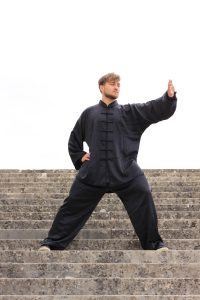
Stage 1 – Energy flows to the hip
A slight rotation to the left allows the arm to sink naturally. The elbow drops along a soft curve while the weight settles into the left leg. The movement feels like releasing – Yang transforming into growing Yin.
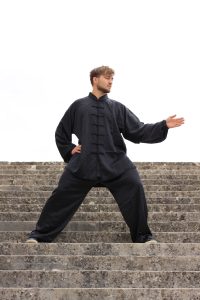
Stage 2 – Energy flows to the Dantian
The weight shifts gently to the right. Without moving the arm independently, the hand rotates upward and comes toward the lower abdomen. Internally, the energy gathers and condenses at the center – full Yin.
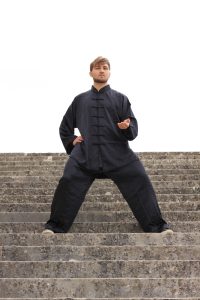
Stage 3 – Energy rises along the spine
Through a controlled rotation to the right, the arm lifts upward as the body spirals. The hand turns downward and aligns with the shoulder. The energy rises through the spine – Yin giving birth to Yang.
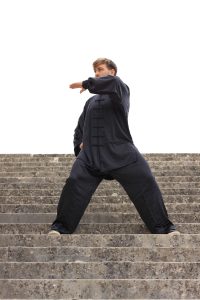
Stage 4 – Energy flows through the arm to the fingertips
The weight shifts back to the left side as the energy extends outward from the center through the arm to the fingertips. The body opens and expands — growing Yang becomes full Yang.
Then return to Stage One and repeat the cycle.
Hand Forms 太極套路
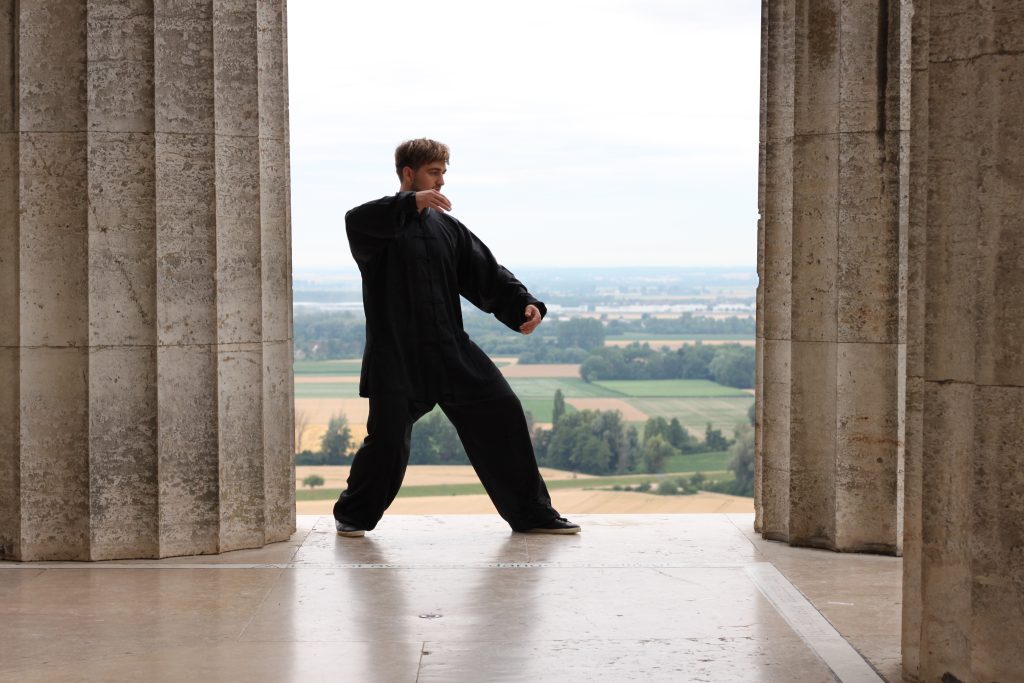
Learning through flowing sequences.
The hand forms consist of structured sequences of postures that embody Tai Chi principles in motion. Each movement connects to the skills developed in standing and silk reeling. Form practice builds flexibility, strength, endurance, coordination, and spatial awareness. Over time, the form becomes a meditative flow that unites precision, rhythm, and internal focus.
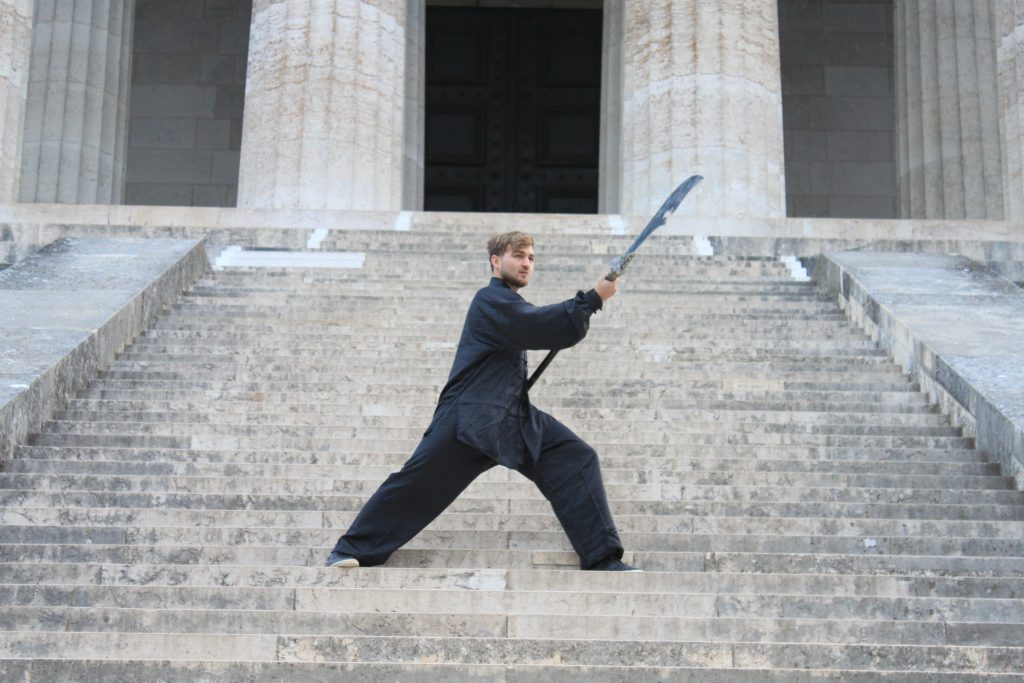
Extending Tai Chi principles through weapons.
In Chen Style, weapon forms are seen as an extension of the body’s movement. Each weapon develops a different quality of focus and energy.
Traditional Chen weapons include:
- Straight Sword (Jian)
- Broadsword (Dao)
- Spear and Long Staff (Qiang / Gun)
- Halberd (Guandao)
- Double Sword
- Double Broadsword
Other tools such as short sticks, Taiji ball, or three-meter staff can also be practiced to deepen coordination and body control.
Weapons Training 太極器械
Push Hands (Tuishou) 太極推手
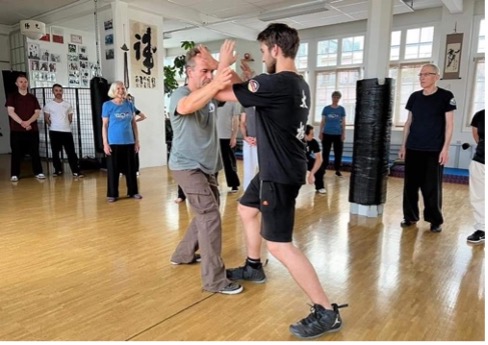
Testing structure and sensitivity with a partner.
Push Hands begins with cooperative drills to refine timing, rooting, and energy awareness. Partners learn to connect, listen, and neutralize force without resistance. Later, the training becomes dynamic and spontaneous, where one learns to maintain structure and calmness even under pressure.
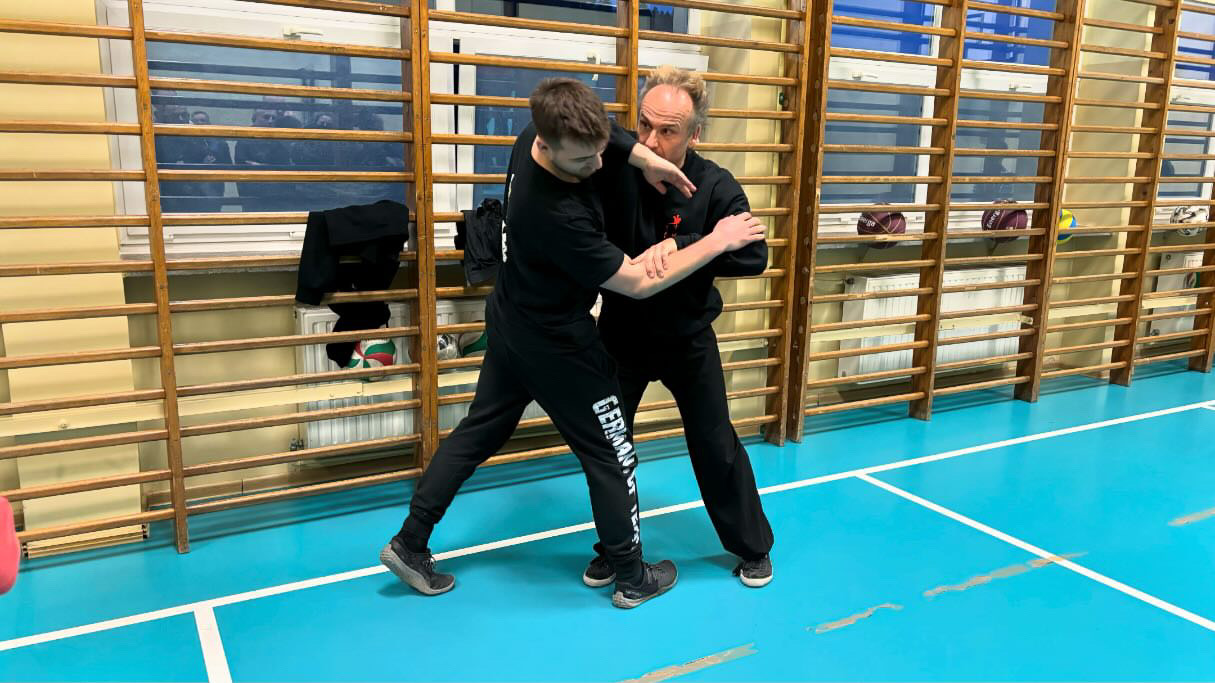
The Chen system contains a rich repertoire of martial applications. Each form movement can be interpreted for striking, locking, throwing, or controlling an opponent. Rather than focusing on isolated techniques, training emphasizes principles – structure, balance, timing, and efficient redirection of force. Through this approach, Tai Chi becomes both an art of health and a method of combat.
Applications and Martial Understanding
If you’d like to learn how Tai Chi is taught and what benefits it offers, click here.
Historical Background
The Chen Style is the original source of all Tai Chi traditions. It emerged in the seventeenth century in Chenjiagou, a small village in Henan Province, where the former general Chen Wangting brought together martial arts, breathing practices, and Daoist philosophy. His goal was to create a system that could train body and mind in harmony – developing both martial skill and inner balance.
Drawing from the combat methods of his time and classical Daoist energy work, Chen Wangting designed a training method that connected awareness, breath, and movement into one continuous flow. The result was a complete art that could be practiced for self-defense, health, and spiritual cultivation alike.
Over the generations, the Chen family refined this system into several routines, most notably the Yi Lu (First Form) and Er Lu or Paochui (Cannon Fist Form). These forms express the essence of Chen Taijiquan: the transformation between softness and power through the spiral energy known as Chan Si Jin (“silk reeling force”).
At its heart, the Chen Style reflects Daoist principles of balance and transformation. Every movement embodies the interplay of Yin and Yang, the dynamic exchange between stillness and motion, yielding and strength. Preserved and transmitted through centuries of dedicated practice, it remains the foundation from which all modern Tai Chi styles evolved — a living tradition that continues to cultivate clarity, resilience, and harmony.